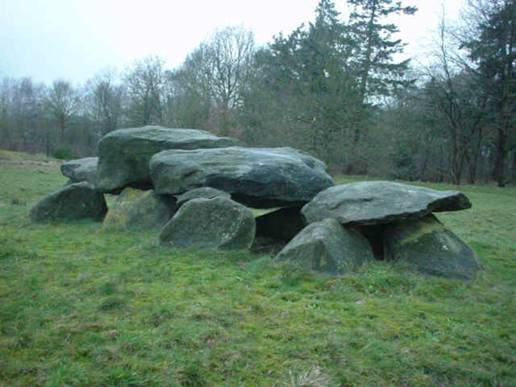
A10.1 The most remarkable remains of the ancient inhabitants can be found
mainly in the province of Drenthe. The Funnelbeaker culture, a late
Neolithic farming culture, buried the dead of their tribe in dolmens, known
as HUNNEBEDDEN. These stone frames were covered with clay.
The tomb was used by the whole community. The culture started to
develop in approximately 3,500 B.C. and vanished around 2,800 B.C.
The relevant history of the Netherlands starts with the arrival of the Romans in the region.
Before that event, the country was hardly inhabited, as circumstances in the muddy low lands made farming difficult. The last remains of the Celtic population and some German tribes succeeded in making a living. Although the FRISIANS had already lived here for a very long time, there is a legend about other German tribes, especially in the north of the country, of which the BATAVIANS and the FRANKS are considered to be the most important.
During their expansion to the north-west of Europe, the legend says that the Romans sent forward German tribes from what now is the Frankfurt region on the Rhine River in order to explore the north. The legend is not clear about whether the exploration was a voluntary mission or a forced one.
)
A10.2 Artificial hills built in order to survive the regular floods in the Netherlands
were used from 700 B.C. These clay constructions provide extensive
historical data. These constructed mounds are called TERPS.
The battle against the sea can be considered as a characteristically Dutch struggle for survival, due to the geographical situation and the need for being protected against the water, as well as the need for land.
This battle started already approximately 700 B.C. with “terps” (artificial mounds) built to create safe ground to build the farmhouses on. In approximately 900 A.D. the building of dikes started in order to dry out wet areas. Some 1000 dikes were constructed in order to protect agricultural areas. In approximately 1200 A.D., the concept of “reclaiming” land from the sea was used for the first time in the north; as techniques evolved, it was no longer necessary to live on terps.
When the Romans arrived in the region which is now the Netherlands, they encountered hostile conditions; the land, the climate and especially the German tribes did not give a hospitable welcome.
)
A10.3 The Roman border in the year 12 A.D.
In 57 B.C. the Romans made their first appearance but it took them up to 12 A.D. before they were able to conquer this part of Europe definitively. This period is also the beginning of written records about the region and its inhabitants. As the land above the Rhine River was considered by the Romans to be uninhabitable and the river offered a better border to protect against German attacks, they settled for a partial solution.
In 476 A.D., with the fall of the last West Roman empire, many little German kingdoms appeared in Western Europe. The kingdom of the Franks, a tribe that originated from the area between the rivers Rhine and Meuse, gained power and influence at the cost of others. In the era of Charlemagne (768-814 A.D.) the Frankish kingdom stretched from Spain to Poland and from Italy to the North Sea.
Governing was organized according to a feudalistic system. The king lent land to local rulers who were allowed to keep the revenues of the land. In return, they owed the king their unconditional loyalty. Local rulers implemented this system for their own regions as well, so a multi-tier structure of governing developed. The king had no residence; he travelled through his country. For this reason, there was no capital city yet.
The conversion of the inhabitants to Christianity begins when the Pope assigned Father Boniface, a priest from England, to convert the German region in 719 A.D. Prior to this year, Boniface made an unsuccessful attempt in the north of the Netherlands. Boniface was an excellent organizer and maintained good relations with Rome and with rulers at all levels. As his rank improved, he even attained the level of archbishop; in 744 A.D. the diocese of Utrecht was added to his responsibilities.
At the age of approximately 80, in 754 A.D., he gave up his archbishopric works in Utrecht and Mainz. He wanted to conclude the work he started as a priest: the conversion of the population in the northern Netherlands. On the 5 th of June of that year, he was slaughtered by locals near the village of Dokkum in the far north of the Netherlands. The locals killed “the apostle of the Germans”, persisting in their own traditional religion. Pope Pius IX declared the day of the 5 th of June a feast day in 1874. He is patron saint to many cities and other institutions.
After the death of Charlemagne, his son Louis was crowned emperor and received empiric dignity from the Pope. According to the Treaty of Verdun in 840 A.D, the area that is now the Netherlands became part of the empire of Lotharius I (grandson of Charlemagne). He was the only one of three brothers permitted by Rome to call himself emperor.
)
A10.4 Division of the Frankish Empire according to the Treaty of Verdun, 840 A.D.
Emperor Lotharius I was the first to be bothered by Viking invaders. As his son Lotharius II died in 869 A.D. without a legal heir, his empire passed to Louis II, known as “Louis the German”, by the Treaty of Mersen (Dutch: Meerssen) in 870 A.D.
As the defence against the Vikings was less a problem to the emperor and more one for the local rulers, the nobles, they gained power and influence. Earldoms such as Flanders, Holland, Utrecht, Brabant and Gelre developed in the area that is now the Netherlands. Local rulers tried to gain control at the cost of the emperor’s power. After the death of Louis “the Child”, in 911 A.D, the empire lost central control.
Between the 10 th and 14 th centuries, the territory of what is now the Netherlands was the subject of struggles between all kinds of landowners amongst themselves on the one hand and against the Emperor, using the power and influence of the church as well, on the other hand. These struggles were accompanied by a great deal of violence as well. Although this territory formally belonged to the German empire (the German Emperor was the official feudal lord up to 1648), in practice the emperor’s role was a pure ceremonial one.
It was the earls of Gelre, Brabant, Holland and Zeeland who became the most powerful and controlled the territories. A consequence of having power was that governmental tasks and obligations became their responsibility as well. Needing funds they traded influence for taxes. As a result, three influential partners emerged: clergy, nobles and citizens (towns). A meeting held among these partners at a regional level was called a meeting of the states or “staten”. This resulted very slowly in a kind of national sense which developed in the Netherlands, as the former adversaries abandoned their once-hostile feelings towards each other. At a national level, this general assembly was known as the “staten general”. The full national parliament in the Netherlands, comprising both upper and lower chambers, is still called the “Staten Generaal” or States General.
A central authority evolved due to strong politics of conquering and marriage maintained by the Burgundies. Although the Dutch areas had been united dynastically since 1299 A.D., Philip the Good, Duke of Burgundy took over control in 1433 A.D. His efforts to create central rural institutes in order to regain control over his country resulted in a country that was once again unified. In 1464 A.D., he called the first meeting of the Staten Generaal to assembly. His granddaughter Maria the Rich was married to Maximilian I of the Austrian Habsburg monarchy. After the death in 1477 A.D. of her father Philip the Brave, son of Philip the Good, the Staten General expressed their loyalty to her. So it was that the Netherlands’ territory switched from the French to the Austrian sphere of influence.
Emperor Charles V (1500-1556 A.D.) headed the “empire where the sun never sets”, merging the Austrian and Spanish dynasties. He is given credit for the final unification of the Dutch nation and the Netherlands. Forced to abdicate in 1555 A.D., he was succeeded by his son Philip II.
In his abdication, Emperor Charles V was physically and emotionally supported by his two favourites; his son Philip II, as mentioned above, and William of Orange.
William, nicknamed “the Silent”, was born in 1533 A.D. in Dillenburg, Germany as Earl of Nassau. He became Prince of Orange in 1544 A.D. and this title included extended possessions in the Netherlands. He was partly raised in Brussels at the court of Maria of Hungary in the Catholic ways, according the emperor’s wishes.
William of Orange, also called “the father of the fatherland”, marked the start of the evolution of the independent national country of the Netherlands. He is therefore also known as William I.
In 1559 A.D., Philip II left for Spain to settle there permanently. He assigned William responsibility for the government of HOLLAND, ZEELAND and UTRECHT. He held the title of “stadhouder” or city steward. The “stadhouder” is the representative of the ruler.
Because these three regions were the most powerful economically, this effectively meant power over the Netherlands’ territories.
Philip II withdrew to Madrid’s Escorial and turned out to be a very Catholic emperor. He ruled his immense empire according to the rules of the Holy Bible without any tolerance or flexibility. It was in the same century that “other approaches” to Christianity appeared. The Reformation in Geneva by John Calvin and the development of the Anglican Church are just two examples of revolts against “the Roman way”. As religion was more important in the daily life of people in those days than it is nowadays, the impact on society and politics was enormous.
)
A10.5 William of Orange (1533-1584 A.D.)
Due to his own background, William of Orange worked on a tolerant policy on religious matters. This policy failed and was not approved by Philip II. As a result of the evolution of several political and religious issues, the “DUTCH WAR OF INDEPENDENCE” occurred. Although many historians still disagree on details about this war, the most likely explanation is as follows:
Developments in society demanded a more flexible attitude from the government on religious matters in the second half of the 16 th century in the Netherlands. Although William of Orange tried to take a tolerant line, the Emperor Philip II did not allow any modifications in the hard-line Roman Way. Opposition to this hard-line policy led to protests and violence. In an attempt to suppress opposition and restore a hard-line policy, the Spanish sent troops. These troops battled troops led by a brother of Willem at Heiligerlee in 1568. This was the start of the Eighty Years War.
During the course of this war, Philip II was rejected in 1581. Elizabeth I of England was approached to be the ruler, but conflicts with her ended in the declaration of the republic.
“De Republiek der Zeven Verenigde Nederlanden” (the Republic of the Seven United Netherlands) was born. This war was ended in 1648 with the peace treaty of Munster. This treaty is the foundation of the modern Netherlands, not including the Flanders regions. The northern Netherlands became a fully independent country.
)
A10.6 The fully independent Netherlands according the Treaty of Munster in
1648 A.D.
The first politician that had to govern the new republic was Johan de Witt. The young republic suffered very difficult years and had to fight many wars. In 1672, political and military developments forced the young republic to re-establish the power of the Prince of Orange at that time (Willem III or Dutch William, 1650-1702 A.D.). Although king of England, he had to settle for the title of “Stadhouder” in the Netherlands in order to bring the Netherlands back to the Orange dynasty again. The final power rested with the Staten Generaal.
Although the constant internal struggle for power between the provincial regions and the central authorities in the Netherlands weakened the country, the Netherlands succeeded as an economical and military power. Its navy ruled the oceans and economical prosperity came with the trade with Asia and the colonisation of outer European areas. The era between 1660 and 1750 is called the Golden Age. The imports of spices especially contributed to the economic prosperity. As France and England were seeking both economical prosperity and military hegemony, political tensions led to many European wars in this era, and the Netherlands were often involved. Its geographical situation, economic prosperity and military power at sea resulted in a hostile attitude of those foreign powers.
Willem III was able to withstand an attack on the Netherlands by France, Cologne and Munster at land and hostilities from the English at sea in 1672 A.D. Through military success he even forced the attacking nations into peace treaties. Europe was to suffer many wars in the years to come. The Republic of the Netherlands was often involved and was able to withstand foreign encroachments and internal disputes up to 1794.
In 1794 A.D., France invaded and the “Stadhouder” Willem V had to go in exile. Republican forces established the Batavian Republic, which ended in 1806 when Napoleon lost faith in local governors and appointed his brother, Louis Napoleon Bonaparte king of the “Koninkrijk Holland” ( Kingdom of Holland).
)
A10.7 King William I
The son of “Stadhouder” Willem V, who had already fought the French in 1794 A.D., returned to the Netherlands in 1803. A constitution was prepared in 1804 and a year later he was installed as king of the Netherlands. The Netherlands consisted of the area of the present Netherlands, Belgium and Luxembourg. He was the first king of the new Netherlands; a constitutional monarchy. The constitution was adapted in 1848 but the present constitution still dates back to 1848 and the Netherlands is still a constitutional monarchy. King William I is therefore considered to be the first ruler of the modern Netherlands.

A 10.8 The coat of arms of the Netherlands
However, the southern Netherlands, the Belgian and Luxembourg territories, were not pleased with the situation that they were forced in 1805 into a single state with the northern Netherlands, and revolted in 1830 A.D. Supported by the French, who were pleased to have a buffer between themselves and the strong Dutch military, they successfully seceded, resulting in a formal and full acknowledgement of the new Belgian state 1840 A.D. King William I then stepped down from the throne and was succeeded by his son King William II.
The second half of the 19 th century and the first years of the 20 th is a period in which industrialisation resulted in extensive social and political changes. Laws on social issues, education, reduction of illiteracy, improvement of democracy and the democratic processes in society were implemented. Political parties developed. Political parties differed in their views on society and all developed their own party. As a result of this, an accompanying denominational segregation in society developed as well. The results of these processes can be seen in the Netherlands even today. Compared to other democratic countries, the number of political parties represented in Parliament is large; many small parties have only a few seats.
Because denominational segregation became slowly to be considered “old-fashioned” and “narrow-minded” in the 1960s, all kinds of forces in society worked from that time on to ban this segregation. Nowadays only remnants can be found, and these remnants hardly obstruct social development.
A policy of neutrality kept the Netherlands out of the First World War. Economic disaster between the two World Wars resulted in the development of extremists in all political fields. This was the basis for a period of political instability.
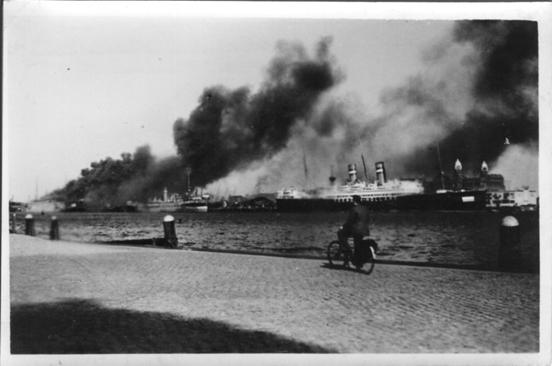
A10.9 The bombing of Rotterdam in May 1940
On the 10 th of May, 1940 A.D., the German Nazi regime started an attack on the Netherlands. Although the foreign policy of the country was one of neutrality, the Netherlands became subject to the aggressive expansion policy of Nazi Germany. Germany’s strategy to attack France from different sides led them to involve the Netherlands’ territories, in order to be able to open a front from the north. The weak Dutch army, as a result of an instable country with a policy of neutrality, was hardly able to resist the invader. After the city of Rotterdam was bombed, the country surrendered on May 15 th. A very difficult period for the population commenced. Deportation of Jews, forced work deportation to German industrial complexes and a lack of all kinds of basic amenities and supplies resulted in a dramatic “Hunger Winter”, the Dutch Famine of 1944/’45.
The war ended for the Dutch on the 5 th of May, 1945. The impact on society was tremendous.
The Germans were forced out by the allied forces and left behind an impoverished country, ravaged by war. The attitude of many of the Dutch towards the Germans is still influenced by the Second World War. These feelings mainly emerge in such areas as politics and sports, although recent surveys show that the “hard feelings” tend to erode.
In June 1945 A.D. a temporary government was installed. A temporary parliament assembled in November of that year and in May 1946 A.D. elections were held in order to bring back the government and the democratic situation back to normal.
Marshall Aid from the United States of America helped the country build up again. In 1951 the Netherlands was one of the founders of “the European Community of Coal and Steel”, the predecessor of today’s European Union.
)
A10.10 The originating partners of the European Union
Since the start of the European cooperation and integration, the Netherlands has always been cooperative and followed a policy of integration. The country sought economic integration because of its commercial export interests, but also integration in other fields as well.
The open and tolerant attitude of the Dutch in combination with the will to share and stimulate the development of others always resulted in a policy of improved cooperation.
An example of this policy is that the Dutch contribute the most per inhabitant to European funds. However, the traditional attitude towards Europe changed in a very short time, due to a number of developments in the first years of the 21 st century, such as the introduction of the euro as an international currency, “the war on terror”, terrorist attacks in various European countries, economic decline at home, reduced forward drive in the Dutch government, the accession of new members to the European community and the possible future accession of Turkey.
Consequently, the very first referendum ever in the Netherlands regarding whether or not to accept a new European constitution, held in the spring of 2005, resulted in a NO.
The Dutch language can be classified as a West Germanic language, part of the Indo-European language group. It is used in the whole country, in the northern part of Belgium ( Flanders) and in a very smart area in the very north-west corner of France (French Flanders).
Due to present and/or historical ties, the language is also used by some inhabitants of Indonesia, all inhabitants of the Dutch Antilles and most inhabitants of Surinam.
In some regions in the province of Friesland, the Frisian language is used. This official language of the province is very closely related to Dutch. A bit more closely related to the English language, it can be classified as North-West German. Because it is a different language, it is used as the official language in some schools and by some municipalities in the province of Friesland. All those who use it are very familiar with the Dutch language as well.
The South African language of Afrikaans also branched off from the Dutch language. The present differences from the Dutch language are due to separate historical development and the influences of native languages and the English language.
Although there are regional dialects, the dialects do not differ much from the official ABN (= algemeen beschaafd Nederlands; common civilized Dutch). ABN is the official form of the language used by authorities and public institutes and is spoken by the majority of the population. The way of using the grammar and words is monitored and enforced by the institute of Dutch lexicology. Their site at www.inl.nl offers detailed information. This Dutch-Belgian institute publishes the “Green Dictionary”, which is the official list of words. The most recent list dates from autumn 2005. One special feature of the most recent list is that many words that originated from slang are incorporated into the official language.
The best way of having an impression of the sound is to listen to Dutch radio. The live program of Radio 1 can be heard on the website at
http://portal.omroep.nl/radio?nav=utzlCsHdDoBlFyG.
In 2005 schools in the small Dutch-speaking part of France started to hire Dutch native speakers to teach some primary school classes. This is a result of the increased number of inhabitants that use the Dutch language. For economic purposes, companies in this region seek applicants for their vacancies from the Netherlands as well. Another remarkable “language export” is that in that very year, the German government approved the hire of a Dutch primary school teacher for a German school close to the Dutch-German border. For reasons of economics and taxes, more and more Dutch citizens are emigrating to Germany and Belgium.
)
A10.11 The Nightwatch by Rembrandt is without a doubt the definitive Dutch work of art.
In the history of painting, the Netherlands truly contributed a great deal of work and a great many excellent painters. As the arts in general were restricted to the church and clergyman exclusively up to the 15 th century, artists worked on commission for the church up to then. Jan van Eyck completed The Adoration of the Lamb altarpiece for the Ghent church in the year 1432. Because Van Eyck used oil paint so well and succeeds in creating depth in his work, he is considered to be the initiator of Dutch painting.
)
A10.12 The Adoration of the Lamb by Jan van Eyck
A large list of world-famous artists emerged. Albert van Oudewater, Geertgen tot Sint Jans, Jeroen Bosch and Lucas van Leiden were the prominent names up to 1600. Carel van Mander published the first book on painting theories in 1604. Hendrick Averkamp pictures landscapes during 1610-20, a period known as the “little ice age” for its extremely cold winters. Hendrick van Brugghen, influenced by Michelangelo, chose Utrecht as his residence in 1614 after a stay in Italy. The most famous of all, Rembrandt van Rijn, was not only mastered the arts at a young age, but was also a master of the arts, attracting many students who learned the art under his tutelage.
)
A10.13 The craftsmanship of expressing light: Jeremiah by Rembrandt van Rijn.
When he reached the age of 22, Gerard Dou joined Rembrandt’s studio in 1628. Jan Steen on domestic situations and Paulus Potter on cattle scenes dominated the second half of the 17 th century. In 1657, Rembrandt was obliged to sell all his possessions. A decline in the artistic level and poor financial management ended in a financial disaster in the 1740s.
Father and son Willem van de Velde moved to England in 1672 in order to paint sea battles.
In 1707, Gerard de Lairesse published his Great Book of Painting, which was later translated into English, German and French.
)
A10.14 The Cannon Shot by Willem van Velde
In the 18 th century, new techniques were used as painters changed over to pastel. Cornelis Troost adapted this technique. In 1808, living artists’ paintings were auctioned off in Amsterdam in order to increase the popularity of the arts among the people. In 1852, Rembrandt was honoured and declared to be a national symbol. As the developing art of photography closely resembled painting, exhibitions were organized in a combination. Johan Barthols Jongkind left for Paris in 1846 and exhibited the only remarkable work at the 1882 Paris Salon, according to Edmond de Goncourt, specialist in the arts.
)
A10.15 Drawbridge with carriage by Vincent van Gogh
Vincent van Gogh, 1887: A photograph taken by the American Muybridge would serve as the inspiration for George Breitner to paint the “ Singel Bridge by the Paleisstraat in Amsterdam”. As photography and movie developed, painters tried to introduce movement into their work as well. In 1896, the first movie was shown in Amsterdam: the arrival of a train. Piet Mondriaan in the 1920s and Carel Appel in the 1930s also had a major international impact. Cooperation with Constant Corneille in the COBRA group started in 1948.

A10.16 Red Blue Yellow by Piet Mondriaan
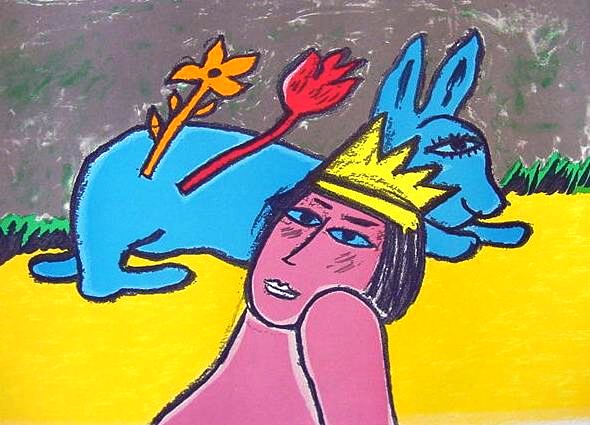
A10.17 Queen by Constant Corneille
The history of Dutch literature originated in the Middle Ages. The geographical area where Dutch literature developed is what is now the Netherlands is, as well as the Dutch-speaking region of Belgium, known as Belgian Flanders.
After the defeat of the civilized Romans by the primitive Germans, the Germans intended to build a new culture. The conversion to Christianity of the Franks resulted in a key role for the church in the developments. The church held many of the treasures of the Roman cultural inheritance, and reading and writing was reserved for clergymen.
Three important periods can be distinguished in the Middle Ages for the arts in general: Early (500-1000 A.D.), High (1000-1300 A.D.) and Late (1300-1500 A.D.) (Renaissance).
As clergymen were the only ones to read and write and Latin was the language of the church, all writing was produced in this language.
In the beginning, all writings had a religious topic; later some writing on civil matters developed as well. It took up to approximately 1100 A.D. before writing literature in local languages developed in Western Europe. The development of cities and the changes in society
towards national countries in which the importance of the nobility grew at the expense of the clergy not only changed the central issue of literature, but resulted in the use of the local languages as well. Chivalry became an important topic in this period.
The earliest texts in Dutch language preserved are by Hendrik van Veldeke (1140-1210 A.D.). Originally from the province of Limburg, his work is considered to be a part of both Dutch and German literature.
Literature was not intended to be read but to be performed by travelling troubadours. Much was written in poetry, because it is easier to remember. Not many books existed in this period, as mechanical book reproduction was not invented until 1450 A.D. Until that time, all books were produced and reproduced manually.
Mechanical book reproduction in the form of printing changed the use of literature: it became a thing to be read. The importance of poetry therefore decreased and “old stories” were written down in prose. Up to 1500 A.D., printed books resembled handwriting because the characters used were in a typeface similar to handwritten characters. From 1501 A.D., books started to be printed using “print” characters and therefore looked more like modern books. This development was completed around 1540 A.D.
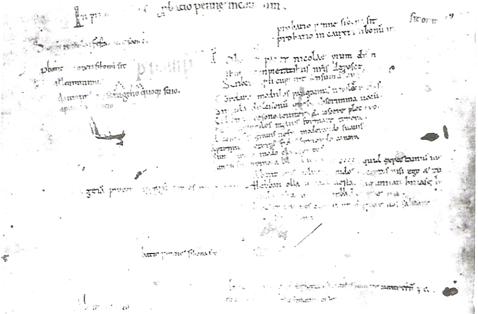
A10.18 The oldest writing in Dutch characters date from the 11 th century.
Discovered in Oxford in 1932, they are from a “pen test” on the
cover of a piece in Latin.
As a common national language was not available in the Middle Ages, all writers used their own dialect. It would go beyond the purposes of this work to go into detail on how the Dutch language developed from many dialects into a national language.
One of the most important works of literature is a long animal fable entitled “Van den vos Reynaerde” or Reynard the Fox, based on the French work “Le roman de Renart”. The estimated origin is in the second half of the 13 th century. The work is a mix of satire and parody.
“Mariken van Nieuwmegen” is the classical piece of literature in Dutch, dated at the end of the Middle Ages, about the eternal struggle between God and the Devil.
In the 16 th century, when the Middle Ages ended, the Dutch nation was struggling for independence. Illegal resistance literature was written in the art of songs. Known as “Geuzenliederen”, these poems, which were the lyrics to the songs, were combined into a book. One of those poems was called the “Wilhelmus”. Probably written by Marnix van Sint-Alegonde, it became the official national anthem of the Netherlands in the 20 th century.
The 16 th and 17 th century brought forward a few writers whose literary works sometimes even go beyond the field of literature. These writers are therefore well-known by the general public as historical figures.
Gerbrand Adriaenszoon Bredero (1585-1618 A.D.)
His work is important as he writes about Amsterdam, which developed during his active period from 30,000 to more than 120,000 inhabitants. He covers a great variety of literary genres; his masterpiece is a comedy entitled “Spaansen Brabander Jerolimo”, about a poor Spanish nobleman in Brabant who pretends to be wealthy.
Pieter Corneliszoon Hooft (1581-1647 A.D.)
His work also encompasses many literary genres. The importance of P.C. Hooft is that he published 20 books during his lifetime on the history of the Netherlands from 1556 (the crowning of Philip II) through 1584 (the assassination of William of Orange). This historical work is remarkable in that it tries to cover the events in an objective, without a Dutch preoccupation.
Jacob Cats (1577-1660 A.D.)
Not only a writer, he made important contributions in business and politics as well. His specialty is poetry that he uses to moralize. Because of his long-lasting popularity, many Dutch proverbs originated from his work.
Constantijn Huygens (1596-1687 A.D.)
His writing career started when he began writing poems at the age of eleven. Spoke seven languages and played many more musical instruments. Architect of his own premises, he corresponded with many scientists all over Europe. Working in diplomatic service, he was well respected. His poetry has didactical intentions in order to contribute to society’s morals.
Joost van den Vondel (1587-1679 A.D.)
The only poet that can be considered the Baroque poet of the Dutch language, he wrote many plays as well. His work can be described as a social criticism. In the beginning, he was not interested in politics but as friends of his get involved in political difficulties, this changed.
His play “PALAMEDES” (1625) pictures Dutch society in an ancient Greek surrounding. He was even fined for this work. His masterpiece is the “Gijsbrecht van Aemstel”. Written especially for the opening of the new Amsterdam theatre in 1637, this work was considered to be the “national” play for centuries.
A special piece of work from this period is the “Statenbijbel”. This “State Bible” was completed in 1637. The authorities decided in 1618 that there was a need for a direct translation of the Holy Bible into the Dutch language for scientific purposes. Up to that time, translations were made from other translations. As every translation causes a loss of validity, a direct translation was needed. This work was a great contribution to the development of the Dutch language.
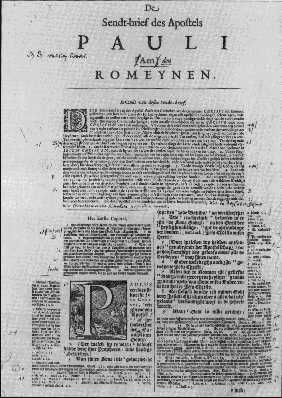
A10.19 A page from the Dutch State Bible
In the 18 th century, the importance of literature in society grew. More and more people learned how to read and write. More and more work appeared. Artistic and social developments went hand in hand. As the Enlightenment replaced the Renaissance, political, religious and social pieces were falling together for many. The influence of the French language became increasingly important in the Netherlands as French became the language of the social elite.
The most important contributions to the development of the Dutch language and literature were made by:
Pieter Langendijk (1683-1756 A.D.)
He used his “Het wederzijds huwelijksbedrog” (“The mutual deception of marriage”) to encourage others to write neoclassic comedies, especially in the Dutch language.
Hubert Korneliszoon Poot. (1689-1733 A.D.)
Poet who romanticized country life.
Justus van Effen (1684-1735 A.D.)
He was raised speaking French but became interested in English because of his travels, during the course of which he met Newton and Swift. He translated works of Swift and Defoe into Dutch. Started writing in French language and contributed to French magazines as well. Started writing in Dutch language later. In 1733, his masterpiece “Kobus en Agnietje: historie van een burgervrijage” (Kobus and Agnietje: history of a burgher courtship) was published in three instalments in a weekly called “De Hollandse Spectator” that Van Effen used to publish on his opinions.
In this period, imaginary travel reports became extremely popular in various countries.
Gerrit Paape (1752-1803 A.D.)
This writer used the name J.A. Schaz M.D. as a pseudonym. His “Reize door het apenland” (Travel through Monkey Country) was the inspiration for Pierre Boule to write “La planète
des singes” in 1963. This work was used by Franklin J. Schaffner to make the world-famous “Planet of the Apes” movies at the end of the 1960s.
In the second half of the 18 th century, reason replaced emotion and pessimism came to the forefront in literature and society. The modern novel emerged in this period as well. Books for children were also published for the first time. Montesqieu, Voltaire and Rousseau became sources of inspiration for many.
Hieronymus van Alphen (1746-1803 A.D.)
Wrote for children in a comprehensive way. Published in 1778 his “Proeve van kleine gedichten voor kinderen” (Sampler of poems for children). “Pruimejantje”, the best known of these poems, is still part of literary education in the Netherlands nowadays.
Betje Wolff (1738-1804 A.D.) and Aagje van Deken (1741-1804 A.D.)
Developed independently but began cooperating in 1777. Their two-volume novel entitled “Historie van Mejuffrouw Sara Burger” (The History of Miss Sara Burger) not only moralizes towards young women but is also a very good description of life in the Netherlands in that period.
In the beginning of the 19 th century, romantic individualism emphasizes one’s own imaginary powers and emotional expressions. Literature in the Netherlands became. Romance went out of fashion. After 1830, realism gained popularity in literature. At an international level, Dickens and Tolstoy appeared on the literary scene. English and American writers became sources of inspiration for many. The most important in Dutch literature in this period are:
A.C.W. Staring (1776-1840 A.D.)
On the borderline between Enlightenment (moralizing poetry using complicated language) and Romanticism (folk and history as sources of inspiration).
Nicolaas Beets (“Hildebrand”) (1814-1903 A.D.)
Writer of the “Camera Obscura”. This description of the lifestyle of the upper elite in Dutch society in the beginning of the 19 th century is still a standard work. Still very popular, this work pictures several persons from the better classes from the point of view of the writer
who makes his observations “as from the dark box of the camera”.
François Haverschmidt (“Piet Paaltjens”) (1835-1894 A.D.)
“Snikken en glimlachjes” is the title of his 1867 masterpiece.
Multatuli (“Eduard Douwes Dekker”) (1820-1887 A.D.)
There is no other writer in Dutch history whose life is as closely linked to his work as Multatuli. Sent to what is now Indonesia, a former colony of the Netherlands, he was appointed to handle administrative duties. He even made a career for himself. He started to write in 1838 but hardly published anything. Bothered by the corruption and the way Dutch rulers enriched themselves at the cost of local inhabitants, he tried to oppose this policy. He did not succeed in his attempt to enforce improvements and critics accused him of not understanding the local situation, although his good intentions were appreciated. He decided to return to Europe and wrote his “Max Havelaar, of de koffij-veilingen der Nederlandsche Handel-Maatschappij”, (Max Havelaar, or the coffee auctions of the Dutch Trading Company) in which he explains the whole rural situation of that time. This description of how local inhabitants in the former colonies were exploited and how corruption by those who governed was widespread is a standard work of Dutch literature.
In 1875, the modern history of the Netherlands commenced. As in most other European countries, industrialisation affected all areas of society. Changes became more extreme and occurred more quickly. New approaches to the arts in general appeared, such as impressionism and naturalism. As literature is a very central area in
society, it adapted accordingly, perhaps even contributing to the changes. Up to World War I, the most important writers were:
Frederick van Eeden (1869-1932 A.D.)
His neo-romantic fairytale “de Kleine Johannes” (Little John) is truly a work of art.
Herman Gorter (1864-1927A.D.)
Poet whose work “Mei” (May) is one of the most frequently researched pieces of work in Dutch literature.
Louis Couperus (1863-1923 A.D.)
Wrote 26 works on several different areas.
Adriaan Roland Horst (1888-1976 A.D.)
Admired in Dutch literature because of the poems he wrote.
With the development of Cubism, Futurism and Expressionism just prior to World War I, literature was affected as well, although it is after the war that the first influences can be noticed. Hendrik Marsman (1899-1940 A.D.) and Fredinand Boldewijk (1884-1965 A.D.) are examples.
The Flemish writer Willem Elschot (1882-1960 A.D.), whose work was hardly considered to be literature in his early years, made a remarkable contribution to Dutch literature between the both World Wars. “Lijmen” (Glues) from the year 1924 is his bestseller. It should be noted that Flemish writers have contributed a great deal to Dutch literature, sharing a language if not entirely the same culture.
Other writers of literary importance between the two World Wars are Simon Vestdijk (1898-1971 A.D.) and Gerrit Achterberg (1905-1962 A.D.), although both continued to be productive after World War II as well.
A remarkable piece of Dutch literature also dates from the Second World War: the Diary of Anne Frank.
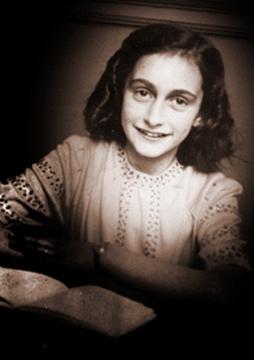
A10.20 Anne Frank
This little Jewish girl had to hide with her family from the Nazis occupying the Netherlands.
Although the Frank family was of German origin, because of her work and suffering, Anne is regarded to be one of the most historical figures from modern Dutch history. The family successfully survived in their Amsterdam hideout. Unfortunately, they were betrayed, so the family was discovered by the Nazis and deported to the concentration camps. Anne did not survive. However, the diary she wrote during her years in hiding has become a monument to the Holocaust, attracting widespread international attention.
)
A10.21 The Anne Frank House in Amsterdam
After the Second World War, the following four writers dominated Dutch literature:
Willem Frederik Hermans (1921-1995 A.D.)
After having published some works of less importance, his “de tranen der accacia’s” (the tears
of the acacias) of 1949 had a great impact. It questioned the importance of the role of the Dutch resistance against the German occupation. “Ik heb altijd gelijk” (I’m always right) of 1951 criticizes the Catholic segment of the Dutch population. He was even sued for this book.
His masterpiece is considered to be “De donkere kamer van Damokoles” (The dark room of Damocles). This work about the beginning of World War II was published in 1958.
Gerard Cornelis van het Reve, born in 1923.
His first publication “De avonden: een winterverhaal” (The Evening: a winter story) from 1947 made him a famous man. It is a novel incorporating autobiographical elements. Changed over to travelogues in 1962 and back to novels in 1978 with “Oud en eenzaam” (Old and Lonely).
Harry Mulisch, born in 1927.
Covers all genres of literature. Translated into many other languages, his work can be considered as a Dutch export product. There is not a special piece of work that can be appointed as is masterwork, although his “Discovery of Heaven” may be his best-known work internationally due to the major motion picture it inspired. His quality is that he is a visionary incorporating fantasy and mystery.
Jan Wolkers, born in 1925.
His remarkable talent is the combination of rough vitality, tenderness, sadism, cynicism
and the use of short, concise sentences without literary embellishments. His most famous works are Kort Amerikaans (1962, Short American), Terug naar Oestgeest (1965, Back to Oestgeest) and Turks Fruit (1969, Turkish Fruit).
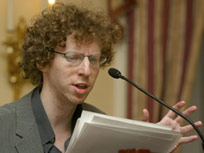
Nowadays in the Netherlands the most popular writer is Arnon Grunberg, born in 1971; he covers many different areas and won many prizes. The internet site www.grunberg.nl offers extensive information on this writer.
A10.22 Arnon Grunberg
Due to the open economy, the small area and the fact that the Dutch language is a difficult language to sing in a musically pleasant sound, there is no traditional folk music. Although there are some nationally well known songs, these songs are mainly songs for children. Some communities do have a local chorus. These choruses use the romance and hard life of the past as themes. Although the country did produce some composers, their work had no cultural impact. Influences from abroad determine Dutch music.
It is very difficult to specify typical Dutch music. Many artists use a foreign language to sing in for artistic (and commercial) reasons; Lee Towers is considered to be very good and the groups The Cats and Golden Earring produced music that gained international recognition. BZN is a very successful group as well, and the George Baker selection conquered the world with their “Oh la Paloma Blanca”. English lyrics are generally preferred by the Dutch public, but there is a large market for Dutch songs as well. There are two groups of Dutch songs; the sentimental “songs of life” and the cabaret songs.
The “songs of life” are considered to be sentimental music for fun without any cultural ambition, to sing along with. In general, the lyrics are about basic life experiences such as love, grief, pleasure and so on. Due to copyright considerations, we suggest that interested readers can surf the Internet and listen to such artists as:
Andre Hazes
Marco Borsato
Frans Bauer
Marianne Weber
Jan Smit
Johnny Jordaan
Willy Alberti
Tante Leen
Vader Abraham
De Zangeres Zonder Naam
The other group of songs emerges from cabaret artists/performers. These artists do have a message in their work. The message is often social criticism or criticism of politics and politicians. In their performances, they switch between singing and telling. Their work is considered to be a contribution to culture, generally of good quality. Due to copyright considerations, it would be better to search the Internet for references, as mentioned above. Some names at random:
Wim Sonneveld
Herman van Veen
Wim Kan
Youp van ’t Hek
Herman Finkers
Because musical preferences are a matter of personal taste, please be aware that the quality of work in the examples mentioned differ; not everything may appeal to individual preferences. Please also note that we explicitly recommend that any Internet searches for examples should be done within legally permitted restrictions, in order not to violate the legal rights of composers or musicians.
A 10.23