The Republic of Poland is a country with a republican political system in which the power is concentrated in the citizens’ hands. Poland is a parliamentary democracy, which means that all citizens can participate in ruling the state and have a constitutionally guaranteed influence on its fate. They also enjoy equal rights.
The Polish political system consists of state institutions, political parties and the legislative powers. Poland is governed by a parliamentary and cabinet system. Power is divided between the legislative body (held by the Sejm , the Senate and, to a certain extent, the Constitutional Tribunal), the executive authority (the President, the Prime Minister, and the Council of Ministers), and the judicial authority (an independent judicial system, with general, administrative, and military courts).
All these elements of the Polish political system are coordinated with each other. During general parliamentary elections the citizens of Poland elect their representatives, who belong to various political parties. These parties then take seats in the Sejm and Senate depending on the number of votes they receive during an election.
The Constitution of Poland is the most important legal document and the basis of the political system. It protects civil rights and freedoms, determines the relationships between the legislative, executive and judiciary powers, decides about the structure and way of appointing the supreme state institutions such as the Sejm (the lower house of the Polish parliament) and Senate (the upper house of the Polish parliament), the President, and the Council of Ministers. Not only the Constitution influences the judiciary, territorial, administrative bodies and the supervisory agencies but also regulates issues concerning the organization of governmental administration, public finance, and extreme situations (states of emergency).
Poland is a forerunner of European constitutionalism. In 1791 the Parliament of the Republic of Poland and Lithuania passed the first constitution in the Old World, later called the 3rd of May Constitution. The present Constitution of Poland, passed by the National Assembly (the Sejm and Senate debating together) on April 2nd, 1997, was approved by the Nation in the Constitutional Referendum of May 25th of the same year.
The Constitution of the Republic of Poland guarantees respect for all the civil rights - the personal, political, economic, social and cultural rights and freedoms - regarded as standard of a democratic country.
The Constitution guarantees all Polish citizens equality before the law (regardless of their sex, race, religion, profession, origin or education), personal freedom and inviolability, inviolability of the home, freedom of conscience and religion, the right to a fair trial (with presumption of innocence until proved guilty), and legal protection of life.
The Constitution protects the right to the inviolability of correspondence, the individual's freedom to express his or her views, his or her freedom of speech, to organize peaceful assemblies, to contribute to the public services, gives the individual citizen's right to vote and stand for election to the government and to receive full information about public authorities’ activities.
The Polish Constitution guards the rights of ownership and inheritance, freedom of choice of profession, the right to proper safety conditions in the workplace. It guarantees minimum wages, protection of health and social benefits, and the right to education (education is obligatory until the age of 18).
The Constitution also guarantees freedom of artistic expression, scientific and scholarly research, freedom of teaching and the access to cultural heritage.
All the organs of the Polish State are obliged to abide by the constitutional law. Especially, this is the task of the Constitutional Tribunal, a court appointed to supervise the compatibility of laws with the Constitution. Every Polish citizen has the right to lodge a complaint to the Constitutional Tribunal against any violation of the Constitution.
The right to vote in parliamentary elections (for a member of the Sejm, the Senate and in presidential elections) is held by all Polish citizens who are 18 and who have not lost their rights by a legal court decision.
Any Polish citizen can become a member of the Sejm provided he or she is 21 years of age on the day of the election. Candidates for the Senate must be 30 on the day of the election, whereas for the presidency, the minimum age is 35 years. All candidates standing in a general election must also have full public rights.
Any lawfully functioning political party may nominate candidates to the Sejm. Elections to the Sejm are also open for independent candidates. A candidate to the office of President of the Republic of Poland must gather at least 100 thousand signatures of Polish citizens eligible for voting.
Electoral law defines the method of voting and standing in elections to the parliament (the Sejm and Senate), the presidency, and local authorities. It also regulates the laws governing referenda.
Elections to the Sejm, the Senate, and the local government are held every four years, and presidential elections every 5 years. In some extraordinary situations, the terms of office of the elected bodies may be shortened or prolonged.
In Poland the right to vote is a privilege that citizens have, however they do not have to exercise it. Absence in an election does not result in any legal or financial liability.
Elections to the Sejm have five characteristic attributes: they are general, equal, secret, direct, and proportional.
The legislative authorities are the Sejm and Senate, which constitute the Polish Parliament.
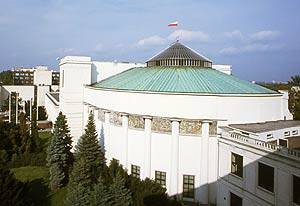
The house of the Sejm, source:www.fotosejm.pl (01)
460 elected deputies sit in the Sejm, and 100 senators in the Senate. Candidates applying for the seat in the Sejm must be citizens of Poland who possess public rights and are at least 21 on the day of the election. Candidates to the Senate must be 30 years old.
The Polish political system is based on a party system. Therefore, in the parliamentary, presidential, and local elections candidates supported by significant political parties have a better chance of success. Parliamentarians belonging to the same political group create their parliamentary clubs within the Sejm and Senate. In practice most of the bills and legislative amendments are prepared within the parliamentary clubs.
Parliamentary deputies work in numerous, permanent or special, committees within the Sejm and Senate, which are established to review various issues related to state administration and public life.
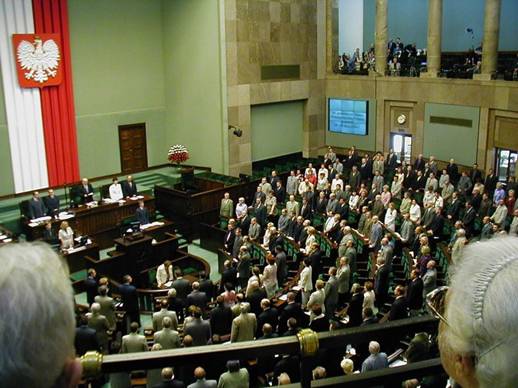
The Sejm debate, source:www.biega.com (02)
New bills are also discussed within the committees. Voting on them in the Sejm committees is a necessary part of the legislative procedure, since it leads to the enactment of new legislation binding on all Polish citizens.
The legislative process begins when a bill is presented to the Speaker of the Sejm (this privilege is granted to the government, the President, the Senate, members of the Sejm or a group of 100,000 citizens).
After the first reading in the Sejm, the bill is rejected or forwarded to a committee and after the amendments are included, it returns to the Sejm for the second reading.
Following a debate and subsequent amendments, members of the Sejm take a final vote on the bill after the third reading. If the bill is passed, it goes to the Senate. The Senate then presents its opinion and proposes amendments.
Then the bill goes back to the Sejm, which can either approve or reject the Senate's amendments. After the decision of the Sejm is made, the bill is presented to the President who can accept and sign it as an act, forward it to the Constitutional Tribunal, or veto it.
Decisions of the Constitutional Tribunal are final. The Presidential veto can be overridden by a 3/5-majority vote, in the presence of at least half of the statutory number of members of the Sejm. If this happens, the President is obliged by law to sign the bill.
On the day of its publication in Dziennik Ustaw (the official journal of laws), the bill becomes the act,provided that the Sejm has passed a vacatio legis procedure, i.e. gives a period of time necessary to prepare for the new provisions.
One of the most important privileges of the Sejm is passing the state budget. In practice, the Sejm decides about state revenue and expenditure, influencing not only the state of the Polish economy or state security, but also the everyday lives of Polish citizens.
The Polish parliament also has very important supervisory powers, such as the right to pass a vote of no confidence, to influence the composition of the Council of Ministers, or set up special enquiry committees to review specific public matters.
The Polish parliament also holds a creative function, having the right to nominate and appoint the highest state officials such as the Ombudsman (the Spokesman for Civil Rights), the Chairman of the Supreme Chamber of Control (the highest audit authority), the Chairman of the National Bank of Poland (who decides about the financial policy of the state), or members of the National Broadcasting Council, which supervises the electronic media market. Parliament's creative function is also reflected in its power to issue a vote of confidence for members of the Council of Ministers proposed by the Prime Minister.
The following bodies co-ordinate the parliamentary work:
The Council of Ministers , i.e. the Polish government, consists of ministers and heads of central institutions.
)
Prime Minister, Kazimierz Marcinkiewicz, source:www.marcinkiewicz.org (03)
The head of the Council of Ministers is the Prime Minister. He proposes the composition of the Council of Ministers and presents it to the President who appoints this Council and takes their oath.
The Council of Ministers also manages the current policy of state, ensures the execution of the law by issuing ordinances, coordinates and controls the work of government administrative bodies, ensures public order and the internal and external security of the state, protects the interests of the State Treasury, approves the draft of the budget and supervises its execution. The Council of Ministers also signs international agreements, which require ratification and can revoke other international agreements. The Council of Ministers is represented in various voivodeships of Poland by regional governors (voivodes). There are 16 of them - one for each voivodeship. The voivodes supervise the state administration within the territory of their voivodeship.
The Supreme Court, the independent State Tribunal, the Constitutional Tribunal and all the courts guarantee the independence of the judiciary in Poland.
The Supreme Court supervises the adjudication in:
The Supreme Court is the court of last resort of appeal against judgments in the lower courts.
It also passes resolutions to clarify specific legal provisions and resolves disputable questions in specific cases.
Its main task is to supervise the compliance of statutory law with the Constitution of the Republic of Poland.
The Constitutional Tribunal adjudicates on the compliance with the Constitution of legislation and international agreements, on disputes over the powers of central constitutional bodies and on compliance with the Constitution of the aims and activities of political parties. It also resolves constitutional complaints.
The Constitutional Tribunal consists of 15 independent judges chosen by the Sejm for 9 years. The Constitutional Tribunal is one of the formal guarantees of the state of law.
It is the judicial body, which resolves the constitutional liability of people who occupy the highest state offices in Poland. The State Tribunal has the right to remove a person from a public office, to forbid the access to some offices higher in rank, to deprive an individual of the right to vote and to stand for election, to withdraw previously awarded medals, distinctions, and titles of honour , and in criminal cases to impose penalties lay down in the criminal code. The head of the office is the First President of the Supreme Court.
)
President Lech Kaczynski, source:www.prezydent.pl (04)
The President of Poland is the head of state, the supreme representative of Poland who guarantees the continuity of the state power. This means that the President, who heads the executive authority, is appointed to represent Polish interests on the international arena and to ensure the obedience to the Constitution. He is also responsible for the security of the state.
The President calls elections to the Sejm and Senate, and in unprecedented situations has the right to shorten their terms. He can call a national referendum, in matters important for the state, which require a decision of all the citizens (such a referendum decided of Poland's accession to the EU).
The President has the opportunity to influence the legislative process by using his veto to stop a bill. As a supreme representative of the Polish state, he ratifies and cancels international agreements, nominates and recalls ambassadors, and accepts the accreditations for foreign representatives. The President also makes decisions concerning the award of state distinctions and orders.
The President is also the Supreme Commander of the Armed Forces, which means that he appoints the Chief of General Staff and the commanders of all the armed forces. During wartime he nominates the Commander-in-Chief of the Armed Forces and can order general mobilisation .
The Constitution states that the local government holds power in ruling the country.
The basic (lowest) organisational unit of the local government is the gmina – an urban or rural administrative district. A few gminas make a powiat. A group of powiats form a voivodeship. At present, in Poland there are 16 of them.
Local government's decision-making and supervisory bodies are the councils, which operate at three levels. The councils make local jurisdictions, supervise the budget, impose local taxes and charges (on the grounds of existing legislature) and adopt resolutions on matters of property rights. The councils appoint and dismiss the local administrative officers such as the wójt – the chief administrator of a gmina, the mayor or a president of a town, the starosta – the chief administrative officer of a powiat - and the marszałek of voivodeship council. Council members are elected in general, direct and equal ballot.
The transformations of 1989 changed the political and party system in Poland. The Polish United Workers' Party, which was the only ruling party of Communist ideology, was forced to give way to political pluralism.
Today in Poland there are conservative, liberal, national, rural-interest, social-democratic and populist parties.
The biggest political parties in Poland are:
The Law and Justice Party (PiS) is a right-wing party, which emphasises the traditions of independence and derives from the Solidarity movement of the 1980s. The PiS represents a right-wing electorate, which supports a traditional social order, a free-market economy, a strong and safe state and the principle of fight against corruption especially among higher rank politicians.
The Citizens' Platform (PO) is a group that represents the liberal electorate, private entrepreneurs and business environment, as well as those who want an affluent state based on a free-market economy and the principle of competition.
The Self-Defence Party (Samoobrona) is a movement that has won the support of those who have been disappointed by the socio-political and economic changes in Poland since 1989. The Self-Defence has the support of voters in rural areas, the unemployed, former state farm workers and unskilled workers.
The Democratic Left Alliance (SLD) was formed in 1999 from several social democratic groups deriving from the former Social Democracy of the Republic of Poland. Some of its members are the former supporters of the Polish United Workers' Party (the previous Communist Party).
The League of Polish Families (LPR) is a party that is popular among people with right wing views. The LPR is one of the few, organised political groups which actively opposed Poland's accession to the EU. The LPR’s activists accept a high level of government intervention in the sphere of economics. The key goal of their party is the protection of national values such as the family, patriotism, religion, freedom and private property.
The Polish Peasants' Party (PSL) is a modern rural-interest party. The PSL represents the interests of farmers and agricultural employees, residents of rural areas and small towns. In large agglomerations it receives small support. The PSL looks back to the national traditions of the large agrarian communities in Poland.
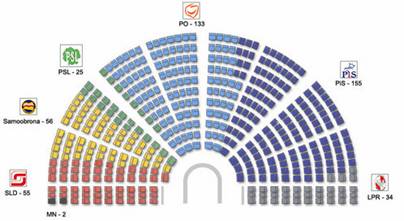
The election to the Sejm, October 2005, - division of seats, source:www.pl.wikipedia.org (05)